

Goal Setting · Habit Tracking
Why Motivation Fades in Week Three—and What Works Next
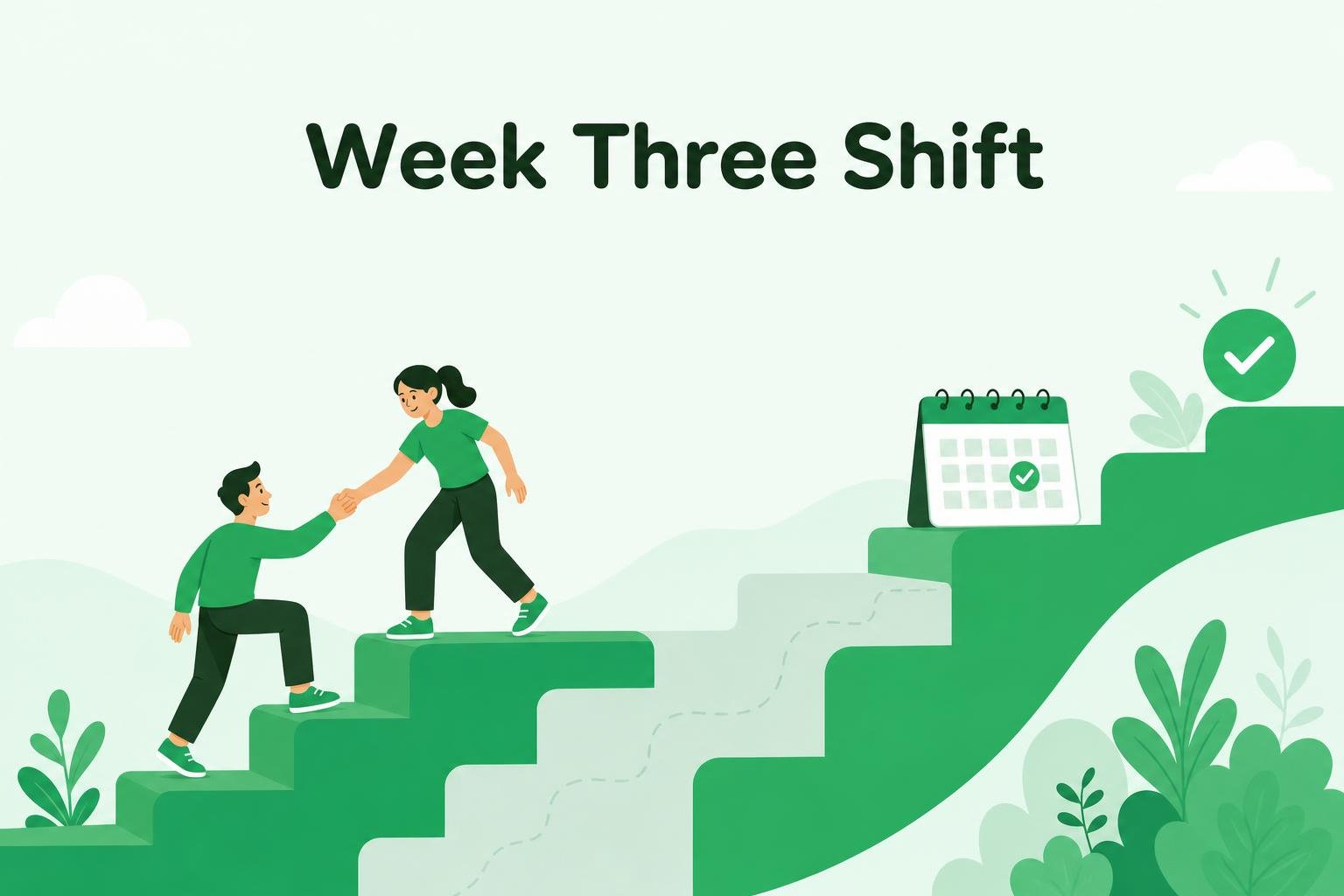
Motivation rarely disappears in one dramatic moment. More often, it gets lighter after the first burst of excitement. The task still matters, but the feeling around it changes. Then week three...
Motivation rarely disappears in one dramatic moment. More often, it gets lighter after the first burst of excitement. The task still matters, but the feeling around it changes. Then week three arrives, and the work can feel less interesting than it did on day one.
That shift is normal. And it is exactly why consistency cannot depend on mood alone.
When motivation drops, reduce the size of the system
At the point where energy starts to dip, the best move is not to force the full plan harder. It is to switch to a smaller repeatable version of the goal. Not the whole routine. Just the next block that can actually be repeated.
That might look like 15 minutes at the same time, one check-in, and one next action. The goal is not to make the task exciting again. The goal is to make it easy to return to when the novelty is gone.
This matters because many ambitious people mistake fading interest for failure. In reality, it is often just the natural end of the initial burst. What carries progress after that is not intensity. It is repeatability.
Why repeatability matters more than mood
When a goal is built around feeling motivated, progress becomes fragile. Some days feel great, and others feel heavy. But a smaller repeatable version creates a steadier path forward, even when energy is uneven.
That is the practical lesson behind habit-building: the easier a goal is to return to, the more likely it is to survive the stretch where enthusiasm drops. The work does not need to be exciting every day. It needs to be accessible enough to restart.
For ambitious individuals, this can be a useful reset. Instead of asking, “How do we stay inspired?” the better question may be, “What version of this goal can we repeat when motivation is no longer doing the work?”
Better questions keep goals moving
According to Goalmate24, this is where accountability becomes especially valuable. A good question can keep a goal moving when motivation has already stepped back. That is the same lesson we can take from Rory McIlroy’s struggle with goal setting, as reported by GOLF.com: better questions can change the way a goal is carried forward.
Different situation, same principle. When the early excitement fades, the next useful step is not to demand more motivation. It is to create a structure that makes returning easier.
What slips first in week three?
Week three is often where the hidden friction shows up. For some people, energy slips first. For others, time feels tighter than expected. And for many, focus is the first thing to go.
That is why the most effective response is not a bigger promise. It is a smaller repeatable version of the goal that removes unnecessary friction and makes the next action obvious.
If a goal feels harder to maintain after the first burst, that does not mean the goal is wrong. It may simply mean the system needs to be simplified.
At Goalmate24, we believe consistency becomes easier when goals are built for the moment motivation fades, not just for the moment it is strongest. The work is not to chase the high of a fresh start. The work is to build a path that still works after the novelty is gone.
So the real question is simple: what usually slips first for you in week three—energy, time, or focus?